
Kathy Bird, a traditional teacher with Matootoo Lake Medicine Lodge, said she first encountered ideas about the sacredness of water early in life when the Elders told children, “never pee in the water.”
While she did not fully understand the significance then, things really came into focus once she entered the Midewin Lodge and began receiving teachings from the grandmothers at Roseau River, Man.

“The Buffalo skull is very sacred. It represents the Buffalo grandfather that comes and helps us, gives us our food, gives us our way of life. That item, the Buffalo skull, if the individual putting the Sundance up doesn’t have one, then he can’t put up a lodge for the Sun. If people understood the significance of these items that they find, they would have a better understanding and lot more respect for the item itself”

These designs, they all originate from dreams. They’re transferred. There’s a ceremony you go through to get the right to have that design… An Elder will conduct the ceremony. There’s a lot to the transfer…. There’s a lot of different little parts in that transfer.

Growing up, plants were as much Dr. Robin Wall Kimmerer’s teachers as were people. So when she went to university and was told she was wrong, that science considered plants and nature as objects and only one species – humans – were most entitled to the riches of the earth, she realized she had “unwittingly stepped out of my Indigenous paradigm.” She came to the conclusion that her way of thinking was not welcomed.

Giihlgiigaa Todd DeVries was taken from his family during the Sixties Scoop and it wasn’t until he was 28 years old that he reconnected. His aunt brought him to the Vancouver Aboriginal Friendship Centre to a Haida Nation house of assembly where all the urban Haidas meet once a year to stay informed of what is happening within the Nation.
Ḵáawan Sangáa, Woodrow (Woody) Morrison, was there and spoke of Haida prophecies. This captured Giihlgiigaa’s attention.

Elder Morris Lewis says he used to wonder how his father and grandfather knew everything about Indian tradition and culture when they didn’t even have a book in front of them.
His experiences as a young lad, which would one day make him a spiritual teacher, were a family affair.

Miskinâhk Iskwew (Turtle Woman) Kokum Lorette Goulet carries her teachings the way a turtle carries its shell: with steadiness and quiet strength.
The Métis Elder has spent her life nurturing healing within her community and with the land itself. Her name, given in ceremony, reminds her to move with patience and purpose and to care for the Earth as a living relative.

Elder Doreen Spence of Saddle Lake Cree Nation in Alberta has spent a lifetime grounding health and wellness in Indigenous culture.
She’s been recognized by universities & Indspire, with the Order of Canada, and has even been nominated for the Nobel Peace prize.
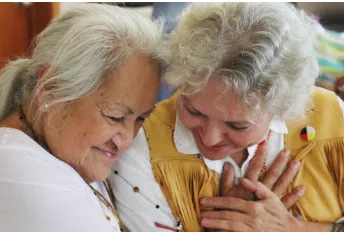
Ojibwe Grandmothers and Elders came together for an apprentice circle called “Walking the Wheel” exploring the teachings of the Medicine Wheel by the seasons. Throughout the 13-month journey, workshop participants engaged in a comprehensive curriculum around coming of age encompassing a wide range of topics, including Roles & responsibilities, Honor of the Creation Story, Sixth Fire and Original Instructions and more!

Historically and, traditionally, it is the right of any wounded warrior to retrieve a fallen eagle feather. The eagle feather is the spirit of a fallen warrior and can only be matched in power by the same. This practice still remains over the centuries and should not be altered because of the consequences. Recording and photographing such a ceremony is strictly forbidden. The spirit will show itself in its own time, especially to the young and innocent

For countless generations our people have told each other stories and legends during the long cold winter nights. There was more time to spend contemplating the meaning of every story. Every person took what meaning he could from these stories and grew wiser in the ways of his people.

There are Seven Fires of Ojibwe creation, It was during the second fire that the circle was created.
“That sacred circle is an essential and important teaching of the Anishinaabe people and tells the story of that wholeness. It is how the Anishinaabe view themselves, how they view their communities and how they view their actions.
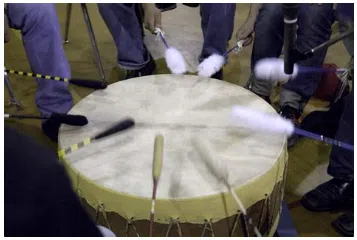
Early drums were often pegged to the ground with four decorated willow staffs that had sacred rattles attached to them to accentuate the sound. Ancient drummers sat on the ground on a bison robe, connected to the Mother Earth. If the drum is the heartbeat of Mother Earth, it is the eagle whistle that sounds with the breath of the Creator.
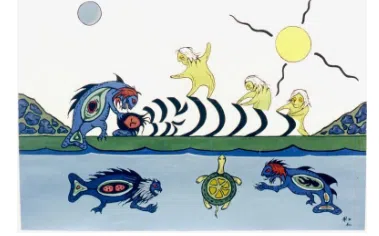
“Sometimes Little People come as helpers. They could bring teachings too and they may be bringing you a lesson in a mischievous way, so you have to always be cautious about them, but then once you’re their friend, they teach you all the good things.”







Comments